Home › Blog › Straumann Implant Guide: Costs, Types, Materials & Lifespan
Oral HealthStraumann Implant Guide: Costs, Types, Materials & Lifespan
November 25, 2026
When replacing missing teeth, patients and clinicians frequently turn to Swiss dental engineering. Founded in 1954 in Basel, Switzerland, the Straumann Group has become one of the most widely researched and clinically documented implant manufacturers globally. This guide examines what makes Straumann implants a benchmark in modern restorative dentistry, covering their proprietary materials, implant designs, expected lifespan, and average global costs.
Why Choose Straumann Dental Implants?
Choosing a dental implant system is a long-term medical decision. While dozens of budget implant brands exist, Straumann commands a leading share of the global market due to three primary clinical advantages:
- Extensive Clinical Evidence: Straumann systems are backed by decades of peer-reviewed, long-term clinical studies. Independent research consistently demonstrates a 10-year survival rate between 95% and 98.8%, minimizing the risk of early implant failure or peri-implantitis.
- Accelerated Healing (SLActive Surface): Standard implants require 6 to 12 weeks to fuse with the jawbone. Straumann's proprietary hydrophilic SLActive surface actively attracts blood proteins and stimulates bone-forming cells, cutting osseointegration time down to 3 to 4 weeks. This makes immediate loading (same-day teeth) safer and improves predictability for patients with diabetes or a history of smoking.
- Global Serviceability: Because Straumann operates in over 70 countries, patients who relocate or travel can easily find a dentist equipped with genuine Straumann prosthetic components, screws, and tools decades after their initial surgery.
Materials Used in Straumann Implants
Material science is where Straumann differentiates itself most clearly from conventional manufacturers. Instead of relying solely on standard commercially pure titanium, Straumann offers three specialized biocompatible options:
- Roxolid (Titanium-Zirconium Alloy): Engineered exclusively by Straumann, Roxolid combines approximately 85% titanium with 15% zirconium. This alloy delivers up to 50% higher tensile and fatigue strength than pure Grade 4 titanium while preserving complete biocompatibility. Because Roxolid is exceptionally strong, dentists can place narrower, shorter implants in areas with low bone volume, often allowing patients to avoid invasive and costly bone grafting procedures.
- Commercially Pure Titanium (Grade 4): The traditional gold standard in implantology. Grade 4 titanium offers proven biological integration and high corrosion resistance, making it suitable for routine cases with healthy, abundant jawbone.
- High-Performance Zirconia (Y-TZP Ceramic): Used in the Straumann PURE Ceramic Implant line, this ivory-colored, 100% metal-free ceramic is designed for patients with metal sensitivities or thin gum tissue where gray titanium might otherwise show through.
Main Types of Straumann Implants
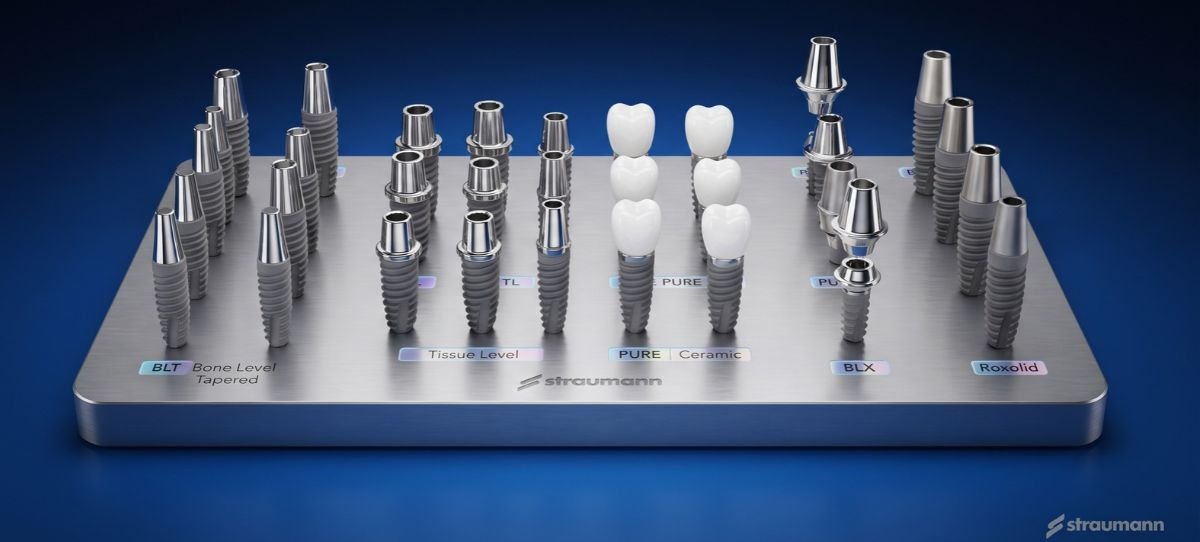
Every patient's jaw anatomy and bite force differ. Straumann manufactures specialized implant lines tailored to distinct surgical requirements:
- Straumann BLX & BLT (Bone Level): Bone Level Tapered (BLT) and BLX implants are placed completely beneath the gum line. Their tapered geometry and aggressive thread design provide high primary stability in soft bone or fresh extraction sockets, making them ideal for immediate implant placement and aesthetically demanding front teeth.
- Straumann TLX & Tissue Level: Designed with a smooth collar that sits at the soft-tissue level, Tissue Level implants eliminate the micro-gap between the implant and abutment beneath the gums. This reduces bacterial accumulation and simplifies daily hygiene, particularly for back molars.
- Straumann PURE Ceramic: A one-piece or two-piece metal-free zirconia system engineered for maximum aesthetics in the smile zone.
- Straumann Pro Arch (All-on-4 / All-on-6): A comprehensive full-arch rehabilitation protocol designed for edentulous patients, anchoring a fixed full-jaw bridge onto four to six strategically angled implants.
- Straumann Zygomatic: Extra-long implants anchored in the cheekbone (zygoma) for patients suffering from severe upper-jaw bone loss who cannot undergo traditional sinus lifts.
How Long Do Straumann Implants Last?
A genuine Straumann titanium or Roxolid fixture is engineered to last a lifetime. Long-term clinical tracking shows survival rates of roughly 95% to 97% at the 20-year mark. However, longevity depends on maintaining healthy surrounding gum tissue and bone. While the internal implant screw rarely needs replacement, the visible prosthetic crown attached to the top experiences daily chewing wear and typically requires replacement every 10 to 15 years. Consistent brushing, interdental cleaning, biannual dental checkups, and avoiding tobacco are essential to maximizing implant lifespan.
Average Prices of Straumann Implants
Straumann is positioned in the premium tier of dental implantology. Final treatment costs vary widely based on geographic location, clinic overhead, surgeon expertise, and whether supplementary procedures like 3D CBCT scans or bone grafts are needed. Below is a comparison of average all-inclusive single-tooth costs (covering the implant fixture, surgical placement, abutment, and final crown):
| Region / Country | Single Straumann Implant (Complete) | Full-Arch Restoration (Per Jaw) |
|---|---|---|
| United States | $3,200 – $6,800 | $20,000 – $30,000 |
| United Kingdom | £2,100 – £5,200 | £15,000 – £25,000 |
| Western Europe (Germany / Switzerland) | €2,500 – €4,500 | €14,000 – €22,000 |
| Turkey (Dental Tourism Hubs) | €850 – €1,500 ($950 – $1,600) | €4,300 – €6,800 |
Step-by-Step Treatment Timeline
Receiving a Straumann implant generally follows four structured phases:
- 3D Diagnostics and Digital Planning: Your clinician captures a 3D cone-beam CT scan and digital intraoral impressions to map nerve pathways and bone density.
- Guided Surgical Placement: Under local anesthesia, the implant is placed into the jawbone. Using SLActive technology, a temporary crown can sometimes be attached the same day.
- Osseointegration Phase: Over 3 to 8 weeks, surrounding bone cells fuse directly onto the microscopic rough surface of the implant.
- Final Prosthetic Restoration: Once full stability is confirmed, a custom-milled zirconia or porcelain crown is secured onto the abutment, restoring full chewing power and natural aesthetics.
Authenticity Verification: The Straumann Implant Passport
Because premium Swiss implants command higher prices, counterfeit fixtures occasionally circulate in unregulated markets. Always request your official Straumann Implant Passport after surgery. This document records the exact batch number, lot code, and implant dimensions, validating your manufacturer lifetime warranty and ensuring any dentist worldwide can service your restoration in the future.