Home › Blog › Dental Implant Cost in Turkey vs Germany: Full Comparison
Dental TourismDental Implant Cost in Turkey vs Germany: Full Comparison
November 25, 2026
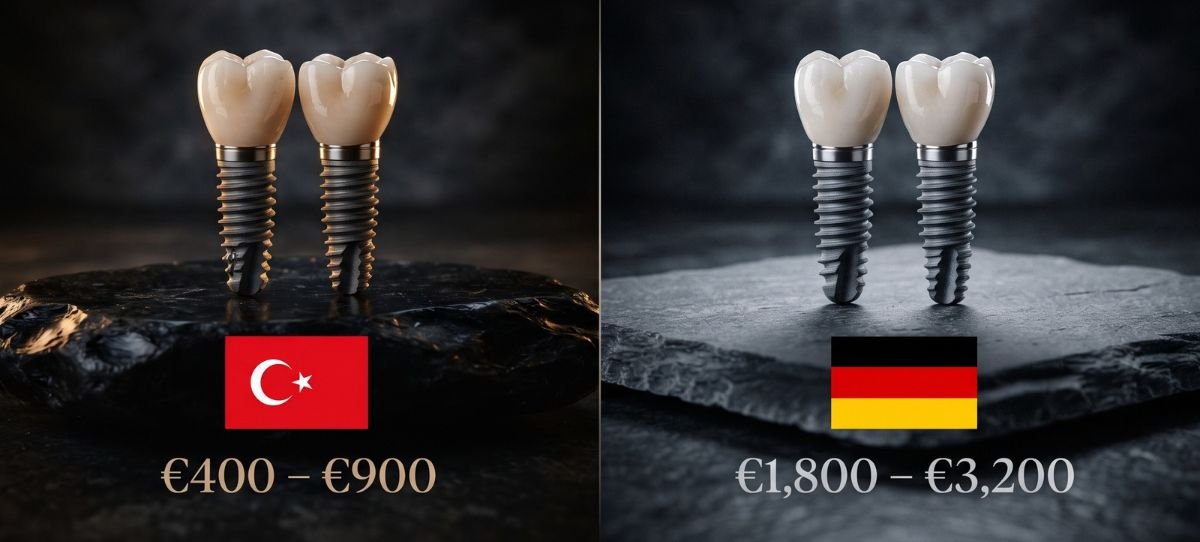
Dental implants are the gold standard for replacing missing teeth, but in Germany they are also one of the most expensive routine dental treatments. Every year, a growing number of German and other European patients look at Turkey instead. This article compares prices, explains what is and is not included, outlines who regulates Turkish clinics, and sets out the reasons patients choose Turkey, along with the risks to weigh honestly.
Prices below are indicative ranges drawn from published 2026 market guides, not quotes. Always request a written, itemised treatment plan.
1. The Price Gap at a Glance
Published comparisons broadly agree that Turkey is 50–70% cheaper than Germany for the same treatment. Typical ranges:
|
Treatment |
Germany |
Turkey |
|---|---|---|
|
Single implant (screw + abutment + crown) |
€1,800 – €3,200 |
€400 – €900 |
|
All-on-4 (one jaw) |
€8,000 – €15,000+ |
€2,500 – €4,500 |
|
Bone graft / sinus lift |
€300 – €1,000+ |
€150 – €400 |
Other sources give wider bands: roughly €1,500–€4,000 or more per implant in Germany, against €500–€1,500 in Turkey, with premium brands such as Straumann sitting near the upper end of Turkish pricing (around €800 for a single implant at many clinics). Wide ranges are normal because price depends on the brand, the crown material, the city and the complexity of your case.
Example: a patient needing three single implants might pay €6,000–€9,600 in Germany and €1,200–€2,700 in Turkey. Even after adding flights and a hotel for two trips, the saving is usually substantial.
2. Why Is Turkey So Much Cheaper?
The difference is not primarily about lower-quality materials. It comes from structural factors:
- Lower operating costs: clinic rent, staff wages and utilities are considerably lower than in Germany.
- Different billing model: German dentists bill under the fee schedule for dentists (GOZ), and anaesthesia, lab work, imaging and materials are often charged separately. Turkish clinics serving foreign patients typically sell bundled packages.
- Volume: Turkey is among the world's most popular dental destinations, attracting hundreds of thousands of dental patients a year, so clinics work at high volume and invest in in-house labs.
- Exchange rates: the weakness of the Turkish lira against the euro strengthens the purchasing power of foreign patients.
3. What Is Usually Included in Turkish Packages
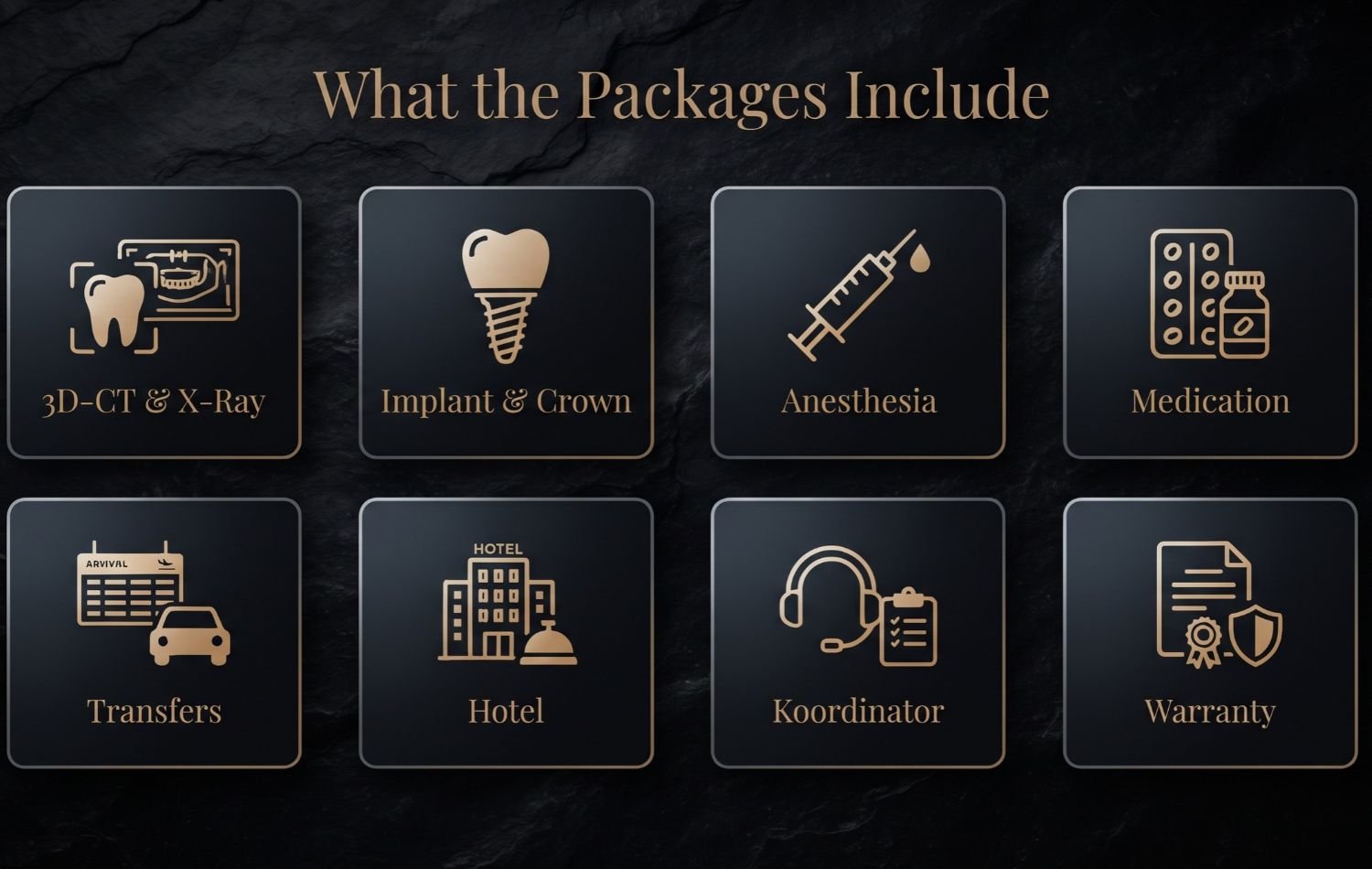
All-inclusive offers vary, but a reputable clinic will normally include:
- Consultation, panoramic X-ray and often a 3D CT scan
- The implant (titanium fixture), abutment and crown
- Local anaesthesia or sedation (check which)
- Standard medication after surgery
- Airport transfers and local transport
- Hotel accommodation, often for the duration of each visit
- A multilingual patient coordinator
- A warranty card for the implant and, commonly, for the prosthetic work
4. What Is Often NOT Included
This is where patients are most often surprised. Confirm in writing whether the following are covered:
- Flights, which are almost never included
- Bone grafting, sinus lifts and extractions, which are frequently priced separately
- Premium implant brands or zirconia crowns, which may carry a surcharge
- Temporary teeth or provisional crowns during healing
- Treatment of gum disease or infections discovered during examination
- Corrections after you return home, such as a loose crown, which usually require another trip or a local dentist
- Meals and personal expenses
- Any complication care outside the clinic's warranty terms
Note also that implant treatment normally needs two trips: one for placement and one, after 2–6 months of healing, for the final crowns. Some clinics offer immediate-loading options, but these are not suitable for every case.
5. What About Germany?
In Germany, the quoted price per implant often covers only the surgical part. The crown, lab fees, anaesthesia and imaging can be billed separately, which is why total costs in Germany run so high. Statutory health insurance (GKV) generally pays only a fixed subsidy toward the prosthetic part, not the implant itself, except in narrow medical cases. Private supplementary insurance may reimburse part of the cost, so check your policy before deciding. The upside of Germany is convenience: no travel, easy follow-up, and legal recourse under German law.
6. Who Regulates Dental Clinics in Turkey?
Several authorities oversee Turkish clinics, and patients can verify most credentials themselves.
Ministry of Health (T.C. Sağlık Bakanlığı). The ministry licenses all healthcare facilities and, through its provincial health directorates, supervises them. A clinic that treats international patients needs an International Health Tourism Authorization Certificate in addition to its normal operating licence. Clinics must run an international patient unit with foreign-language staff and report their activity through the ministry's digital system.
USHAŞ (International Health Services Inc.). Founded in 2019 under the ministry, USHAŞ coordinates health tourism and runs the official HealthTürkiye platform, which lists certificated providers. Under the regulation published in the Official Gazette on 26 April 2025, which replaced the 2017 rules, USHAŞ issues authorization to intermediary agencies, and evaluates facilities and intermediaries at least once a year. Certificates can be suspended or revoked if standards are not met, and their validity is tied to HealthTürkiye performance criteria.
Turkish Dental Association (TDB). The professional body for dentists, which dentists must be registered with to practise.
Turkish Medicines and Medical Devices Agency (TİTCK). Oversees the registration and safety of medical devices, including dental implants sold in Turkey.
Voluntary accreditation. Some clinics hold ISO certificates (such as ISO 9001) or JCI accreditation, which is common among larger hospital groups. These are optional extras that need independent confirmation.
By comparison, Germany is regulated by the state dental chambers (Landeszahnärztekammern), the Federal Dental Association (Bundeszahnärztekammer) and the statutory insurance dentists' associations (KZV), with strict rules on hygiene, documentation and patient rights.
How to verify a Turkish clinic: ask for the clinic's licence and Health Tourism Authorization Certificate, check it on the HealthTürkiye list, confirm the dentist's registration, and request the implant brand's passport card with batch numbers.
7. Reasons to Choose Turkey for Dental Implants
- Major cost savings. Often 50–70% below German prices, even after travel.
- Established expertise. Turkish dentists treat large numbers of international patients, and implantology is a core practice in many clinics.
- Modern technology. 3D CT planning, digital scanning, guided surgery and in-house CAD/CAM labs are widespread.
- Top-tier implant brands. Straumann, Nobel Biocare and similar systems are available.
- Short waiting times. Appointments are typically available within days or weeks rather than months.
- All-in-one packages. Treatment, hotel and transfers are arranged by a single coordinator.
- Tourist-friendly cities. Istanbul, Antalya, Izmir and Kuşadası combine treatment with a holiday. Prices in Antalya or Izmir are often marginally lower than in Istanbul.
- Government oversight. A formal authorization system exists specifically for international patients.
- Warranties. Many clinics offer written warranties on implants and prosthetics.
- Convenient flights. Direct connections from most German cities take roughly three to four hours.
8. More Benefits
- Treat more for the same budget. Savings can allow full-mouth rehabilitation or better materials such as zirconia.
- Combined treatments. Implants, veneers, whitening and hygiene can be done in one stay.
- Language support. Many clinics employ German- and English-speaking staff.
- Transparent, fixed pricing. Well-run clinics give a written quote before you travel.
- Remote pre-assessment. Panoramic X-rays can be reviewed by video call before you commit.
- Recovery in a pleasant setting, with local food and weather often better suited for rest.
9. Risks and How to Reduce Them
Honesty matters here. Dental tourism has real downsides:
- Follow-up care is harder. Complications may appear months later, when you are back in Germany. Some German dentists decline to treat or take over implants placed elsewhere.
- Legal recourse is limited. Disputes are subject to Turkish law.
- Rushed treatment. Beware clinics that promise full treatment in very few days or push more work than you need.
- Variable quality. Standards differ between clinics; price alone is a poor guide.
- Hidden extras. Vague packages can grow in cost.
To protect yourself: choose a clinic with a verified authorization certificate; get a CT-based written treatment plan and itemised quote; ask about the implant brand and warranty terms in writing; read independent reviews, not just testimonials on the clinic's own site; and consult your local dentist before and after treatment. Allow a minimum of two visits, and a margin for unexpected costs.
10. Conclusion
For most patients, Turkey offers a genuinely large cost advantage over Germany, commonly saving thousands of euros on a single implant case and far more on full-arch treatment. The savings are real, and the regulatory framework for international patients has tightened in recent years. But the cheapest quote is not necessarily the best choice. Verify the clinic's licence, insist on written itemisation and warranty terms, and plan for follow-up care. Treat dental implants as a medical decision first and a bargain second, and a well-chosen Turkish clinic can deliver quality results at a fraction of the German price.
Disclaimer: This article is for general information only and is not medical, legal or financial advice. Prices and regulations change, so verify current details with the clinic, the Turkish Ministry of Health or HealthTürkiye, and consult a qualified dentist about your own case.